
FEMA Storm Shelter Guidelines Explained in Plain English
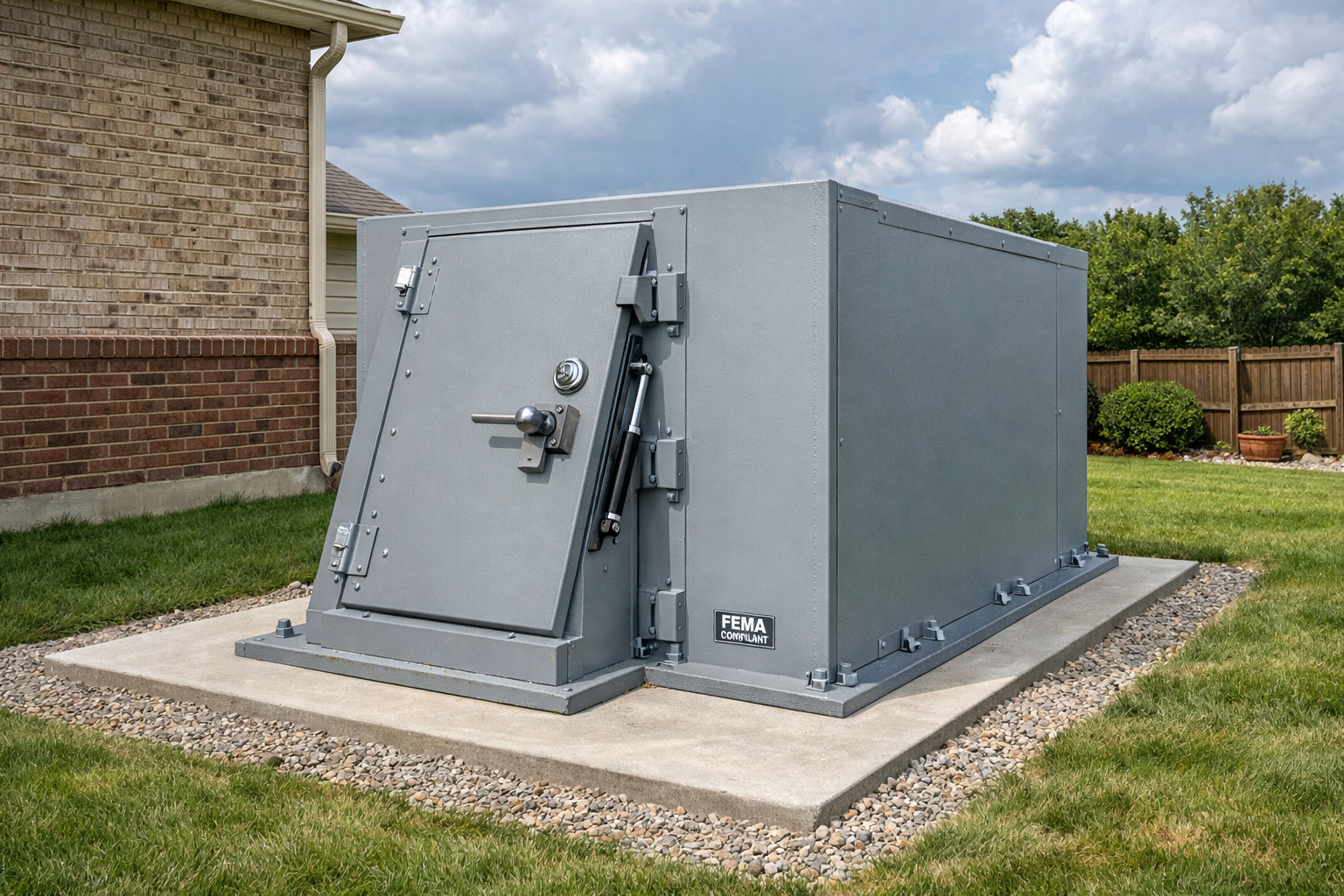
What FEMA Storm Shelter Guidelines Really Mean for Homeowners
If you have researched tornado protection, you have likely seen the phrase “meets FEMA storm shelter guidelines.” It sounds reassuring, but what does it actually mean?
For many homeowners across the United States, the terminology can feel technical and confusing. However, FEMA storm shelter guidelines are not marketing phrases. They are engineering-based standards developed to protect lives during the most extreme wind events, including EF4 and EF5 tornadoes.
These guidelines outline how shelters must be:
- Designed
- Constructed
- Anchored
- Impact tested
- Installed
Understanding FEMA storm shelter guidelines helps you:
- Make informed purchasing decisions
- Verify whether a shelter is truly compliant
- Understand differences between storm shelters and safe room storm shelters
- Protect your family with confidence
Let us break these requirements down clearly and simply.
What Are FEMA Storm Shelter Guidelines?
FEMA storm shelter guidelines primarily reference two key documents:
- FEMA P-320 – Guidance for residential safe rooms
- FEMA P-361 – Guidelines for community safe rooms
When people reference FEMA P-361, they are referring to detailed engineering criteria for constructing shelters that protect occupants during extreme wind events.
It is important to understand that FEMA does not “approve” or certify individual shelters. Instead, compliance is measured against the ICC 500 standard, the International Code Council’s official benchmark for storm shelter performance.
In simple terms, FEMA storm shelter guidelines require shelters to:
- Withstand wind speeds up to 250 mph
- Resist impact from high-speed debris
- Maintain structural integrity under extreme pressure changes
- Provide safe entry and exit before and after a storm
Shelters built to meet ICC 500 and FEMA P-361 criteria are considered FEMA compliant storm shelters.
FEMA Tornado Shelter Guidelines: Key Requirements Explained
1. Wind Speed Resistance
Under FEMA tornado shelter guidelines, shelters must withstand wind speeds equivalent to an EF5 tornado. That means up to 250 mph in tornado-prone regions.
Most residential homes are not engineered to survive winds of that magnitude. A properly designed shelter must remain structurally intact even if the surrounding building fails.
This is one of the most critical tornado shelter requirements.
2. Impact Testing for Flying Debris
Tornadoes transform everyday objects into dangerous projectiles. Under ICC 500 and FEMA P-361 standards, shelter walls and doors must withstand impact from a 15-pound wooden 2x4 traveling at approximately 100 mph.
If a shelter wall or door fails this test, it does not qualify as FEMA compliant.
Impact resistance is essential because flying debris causes many tornado-related fatalities.
3. ICC 500 Door Standards
Doors are often the weakest part of any structure. An ICC 500 door must meet strict impact and pressure resistance standards.
FEMA storm shelter guidelines require:
- Reinforced steel construction
- Inward-swinging doors in many residential designs
- Heavy-duty locking mechanisms
- Impact-tested hinges and frames
A door that has not been tested to ICC 500 standards may fail even if the rest of the shelter is strong.
4. Proper Anchoring and Installation
Even the strongest shelter will fail if not anchored correctly. FEMA storm shelter guidelines require shelters to be secured to a concrete slab or foundation engineered to withstand uplift and lateral forces.
Improper installation is one of the most common causes of failure.
Professional installation ensures compliance with tornado shelter construction standards and ICC 500 anchoring requirements.
5. Ventilation and Occupant Safety
Storm shelter design must also account for:
- Adequate ventilation
- Maximum occupancy limits
- Emergency egress
- Accessibility considerations for community shelters
Ventilation systems must allow airflow while preventing debris intrusion.
For residential safe room storm shelters, occupancy calculations ensure there is enough space per person during extended shelter periods.
Residential vs Community Shelter Requirements
While core engineering standards remain consistent, FEMA storm shelter guidelines differ slightly between residential and community installations.
Residential Safe Room Storm Shelters
- Designed for one household
- Often installed in garages, basements, or outdoors
- Must meet ICC 500 performance standards
- Follow FEMA P-320 recommendations
Community Shelters
- Designed for schools, offices, factories, and public facilities
- Must comply with FEMA P-361 guidelines
- Require higher occupant capacity calculations
- May require ADA accessibility compliance
Both types must meet ICC 500 standards to be considered FEMA compliant storm shelters.
Tornado Shelter Construction: What Really Matters
When evaluating tornado shelter construction, focus on engineering integrity rather than marketing claims.
Key components include:
- Structural steel thickness
- Weld quality
- Anchor bolt strength
- Door reinforcement
- Debris impact testing documentation
A shelter that meets FEMA storm shelter guidelines should provide documentation proving ICC 500 compliance.
Homeowners should ask for engineering reports and testing certifications before purchasing.
Real-World Applications Across the United States
Homeowner in Tornado Alley
A family in a high-risk tornado state installs an above-ground steel shelter rated for 250 mph winds. Because it meets ICC 500 standards referenced in FEMA P-361, it provides verified protection during severe outbreaks.
If you are unsure about local storm risk, understanding the difference between a tornado watch vs warning can help clarify preparedness levels.
Alabama Installation
Residents in the Southeast often install shelters due to frequent severe storms. If you live in the region, you can explore service coverage for Alabama storm shelters to understand local options.
Regional weather patterns make FEMA compliant storm shelters especially important in these areas.
Storm Mode Preparation
Preparation goes beyond installation. Learning how to activate safety procedures during severe weather is essential. Tools like Storm Mode resources can help families prepare in advance.
FEMA storm shelter guidelines provide the engineering foundation. Preparedness practices provide the execution.
Common Misconceptions About FEMA Storm Shelter Guidelines
FEMA Does Not Approve Individual Shelters
FEMA publishes guidance such as FEMA P-361, but it does not certify brands or manufacturers.
Compliance is determined by adherence to ICC 500 standards.
Above-Ground Shelters Can Meet FEMA Standards
Many people assume only underground shelters qualify. In reality, above-ground shelters can fully comply when properly engineered and anchored.
Not All Steel Shelters Are Compliant
Material alone does not determine compliance. Impact testing, door reinforcement, anchoring, and engineering calculations all matter.
Local Codes May Require ICC 500 Compliance
Some states and municipalities have adopted ICC 500 into building codes. In these areas, tornado shelter requirements are legally enforceable.
Always verify local code requirements before installation.
Why Understanding FEMA Storm Shelter Guidelines Protects Your Investment
FEMA storm shelter guidelines exist for one purpose: saving lives.
When a shelter is designed and installed according to FEMA P-361 and ICC 500 standards, it provides a verified level of protection against catastrophic wind events.
For homeowners and business owners, understanding these guidelines:
- Eliminates guesswork
- Helps verify manufacturer claims
- Ensures engineering integrity
- Protects long-term investment
- Provides peace of mind
When severe weather strikes, compliance matters. Engineering matters. Documentation matters.
Choosing FEMA compliant storm shelters ensures your protection is based on tested performance, not marketing language.
Frequently Asked Questions About FEMA Storm Shelter Guidelines
What are FEMA storm shelter guidelines based on?
They are primarily based on ICC 500 standards and detailed engineering guidance in FEMA P-361 and FEMA P-320.
What is FEMA P-361?
FEMA P-361 is a publication that outlines design and construction criteria for community safe rooms capable of withstanding extreme wind events.
What is an ICC 500 door?
An ICC 500 door is a storm shelter door that has been tested and certified to withstand debris impact and extreme wind pressure as required by the ICC 500 standard.
Can above-ground shelters meet FEMA storm shelter guidelines?
Yes. Properly engineered above-ground shelters can fully comply with ICC 500 and FEMA standards.
Are FEMA storm shelter guidelines required nationwide?
Requirements vary by state and municipality. Some jurisdictions have adopted ICC 500 into building codes, making compliance mandatory.
Understanding FEMA storm shelter guidelines empowers homeowners to prioritize safety with clarity. When tornado shelter construction meets FEMA P-361 and ICC 500 standards, protection is based on proven engineering, not assumptions.